Using Large Language Model Annotations for the Social Sciences: A General Framework of Using Predicted Variables in Downstream Analyses
Conditionally accepted at American Journal of Political Science.
Abstract
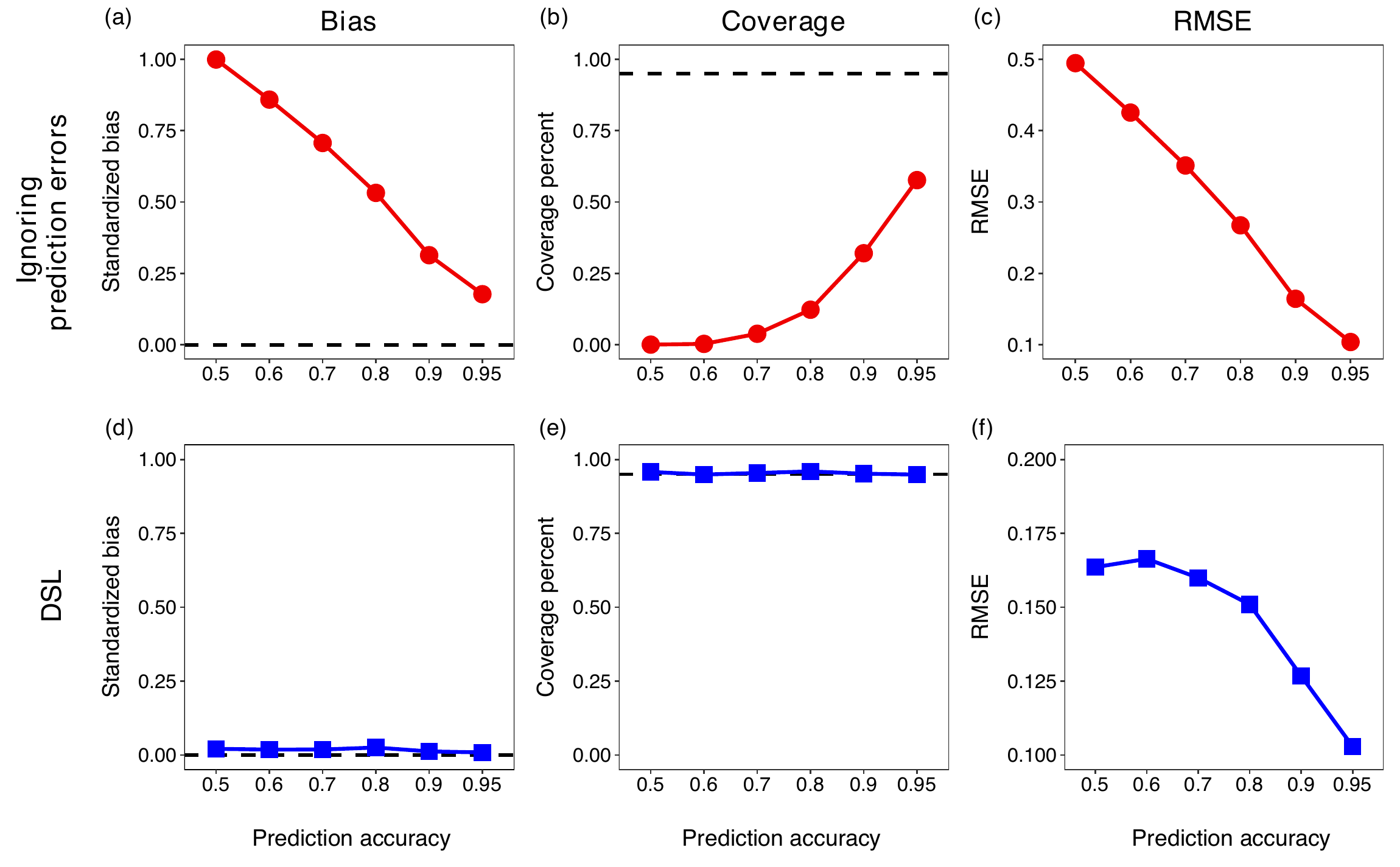
Social scientists use automated annotation methods, such as supervised machine learning and, more recently, large language models (LLMs), that can predict labels and generate text-based variables. While such predicted text-based variables are often analyzed as if they were observed without errors, we show that ignoring prediction errors in the automated annotation step leads to substantial bias and invalid confidence intervals in downstream analyses, even if the accuracy of the automated annotations is high, e.g., above 90%. We propose a framework of design-based supervised learning (DSL) that can provide valid statistical estimates, even when predicted variables contain non-random prediction errors. DSL employs a doubly robust procedure to combine predicted labels and a smaller number of expert annotations. DSL allows scholars to apply advances in LLMs to social science research while maintaining statistical validity. We illustrate its general applicability using two applications where the outcome and independent variables are text-based.
Related Publications
- [Conference Proceedings] Using Imperfect Surrogates for Downstream Inference: Design-Based Supervised Learning for Social Science Applications of Large Language Models
- [Paper] Correcting the Measurement Errors of AI-Assisted Labeling in Image Analysis Using Design-Based Supervised Learning
- [Paper] Fine-Tuned Large Language Models Can Replicate Expert Coding Better Than Trained Coders: A Study on Informative Signals Sent by Interest Groups
- [Conference Proceedings] GPT Deciphering Fedspeak: Quantifying Dissent Among Hawks and Doves
- [Working Paper] Where's the Evidence that Respondents Understand Your Survey Questions?
- [Conference Proceedings] AutoPersuade: A Framework for Evaluating and Explaining Persuasive Arguments
- [Paper] How to Make Causal Inferences Using Texts
- [Conference Proceedings] EgoPolice: A Benchmark for Egocentric Video Understanding in High-Stakes Police Body-Worn Camera Footage