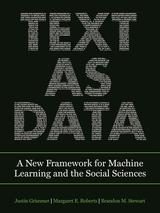
Text as Data: A New Framework for Machine Learning and the Social Sciences
Princeton University Press, 2022.
Abstract
From social media posts and text messages to digital government documents and archives, researchers are bombarded with a deluge of text reflecting the social world. This textual data gives unprecedented insights into fundamental questions in the social sciences, humanities, and industry. Meanwhile new machine learning tools are rapidly transforming the way science and business are conducted. Text as Data shows how to combine new sources of data, machine learning tools, and social science research design to develop and evaluate new insights. Text as Data is organized around the core tasks in research projects using text—representation, discovery, measurement, prediction, and causal inference. The authors offer a sequential, iterative, and inductive approach to research design. Each research task is presented complete with real-world applications, example methods, and a distinct style of task-focused research. Bridging many divides—computer science and social science, the qualitative and the quantitative, and industry and academia— Text as Data is an ideal resource for anyone wanting to analyze large collections of text in an era when data is abundant and computation is cheap, but the enduring challenges of social science remain.
Reviews
- Organization Studies 47(3): 540-543, 2026.
- Technometrics 67(2): 358-359, 2025.
- Intersections. East European Journal of Society and Politics 10(4): 160-165, 2024.
- Administrative Science Quarterly 69(3): NP49-NP52, 2024.
- Contemporary Sociology 53(1): 44-46, 2024.
- Contemporary Sociology 52(4): 347-348, 2023.
- Réseaux 238-239(2): 331-334, 2023.
- Digital Scholarship in the Humanities 38(1): 458-460, 2023.
- Sociological Methods & Research 51(4): 1868-1885, 2022.
- New Media & Society 24(9): 2186-2188, 2022.
Related Publications
- [Paper] Machine Learning for Social Science: An Agnostic Approach
- [Conference Proceedings] TopicCheck: Interactive Alignment for Assessing Topic Model Stability
- [Conference Proceedings] Computer-Assisted Content Analysis: Topic Models for Exploring Multiple Subjective Interpretations
- [Paper] A Model of Text for Experimentation in the Social Sciences
- [Paper] Computer-Assisted Text Analysis for Comparative Politics
- [Paper] Structural Topic Models for Open-Ended Survey Responses
- [Paper] How to Make Causal Inferences Using Texts
- [Paper] Causal Inference in Natural Language Processing: Estimation, Prediction, Interpretation and Beyond