Structural Topic Models for Open-Ended Survey Responses
American Journal of Political Science 58(4): 1064-1082, 2014.
Abstract
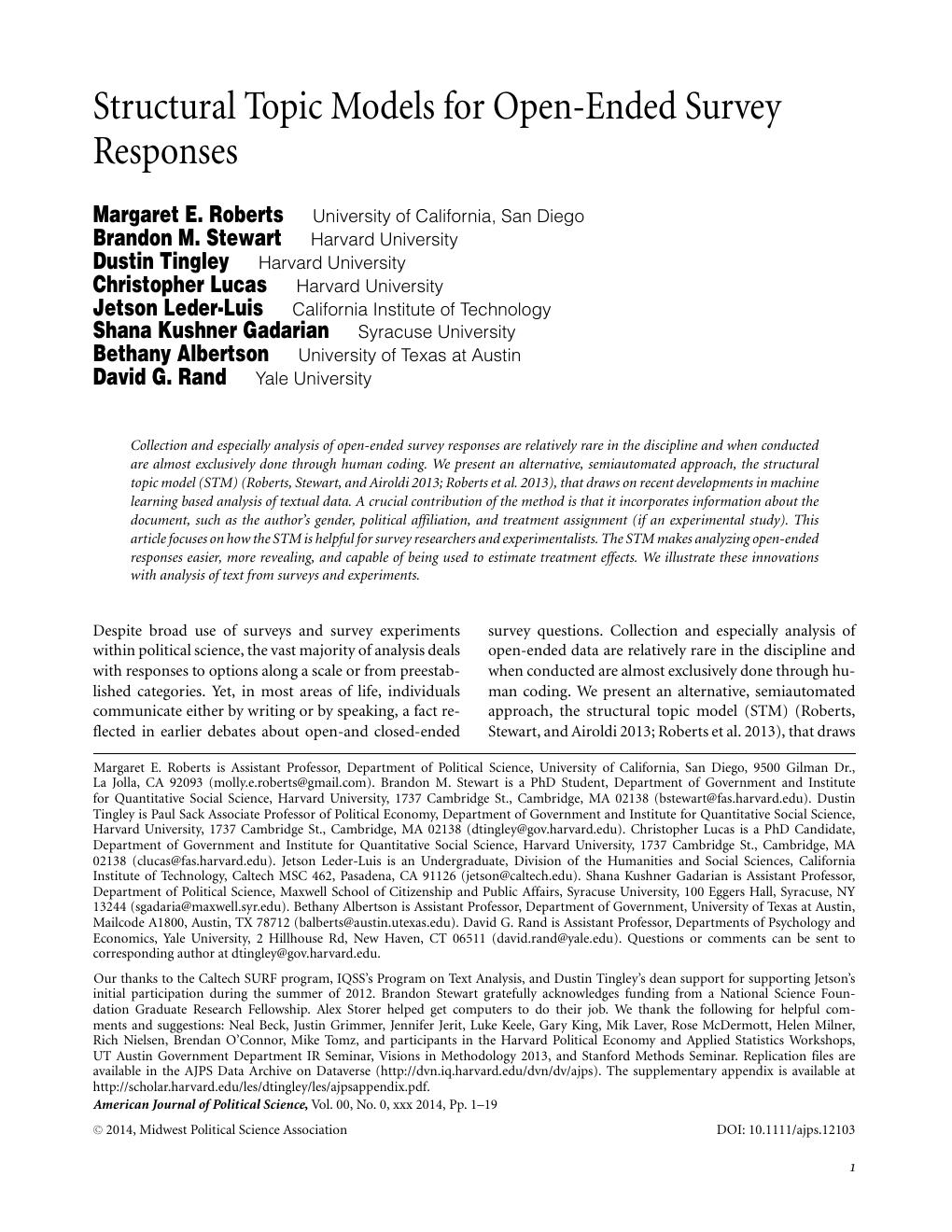
Collection and especially analysis of open-ended survey responses are relatively rare in the discipline and when conducted are almost exclusively done through human coding. We present an alternative, semi-automated approach, the structural topic model (STM) (Roberts, Stewart, and Airoldi 2013; Roberts, Stewart, Tingley, Lucas, Leder-Luis, Gadarian, Albertson, and Rand 2013), that draws on recent developments in machine learning based analysis of textual data. A crucial contribution of the method is that it incorporates information about the document, such as the author’s gender, political affiliation, and treatment assignment (if an experimental study). This article focuses on how the STM is helpful for survey researchers and experimentalists. The STM makes analyzing open-ended responses easier, more revealing, and capable of being used to estimate treatment effects. We illustrate these innovations with analysis of text from surveys and experiments.
Related Publications
- [Paper] Computer-Assisted Text Analysis for Comparative Politics
- [Conference Proceedings] TopicCheck: Interactive Alignment for Assessing Topic Model Stability
- [Conference Proceedings] Computer-Assisted Content Analysis: Topic Models for Exploring Multiple Subjective Interpretations
- [Book] Text as Data: A New Framework for Machine Learning and the Social Sciences
- [Paper] Computer-Assisted Reading and Discovery for Student Generated Text in Massive Open Online Courses
- [Paper] Topics, Concepts, and Measurement: A Crowdsourced Procedure for Validating Topics as Measures
- [Paper] stm: An R Package for Structural Topic Models
- [Paper] What Makes Foreign Policy Teams Tick: Explaining Variation in Group Performance at Geopolitical Forecasting