State Media Control Influences Large Language Models
Nature, 2026.
Abstract
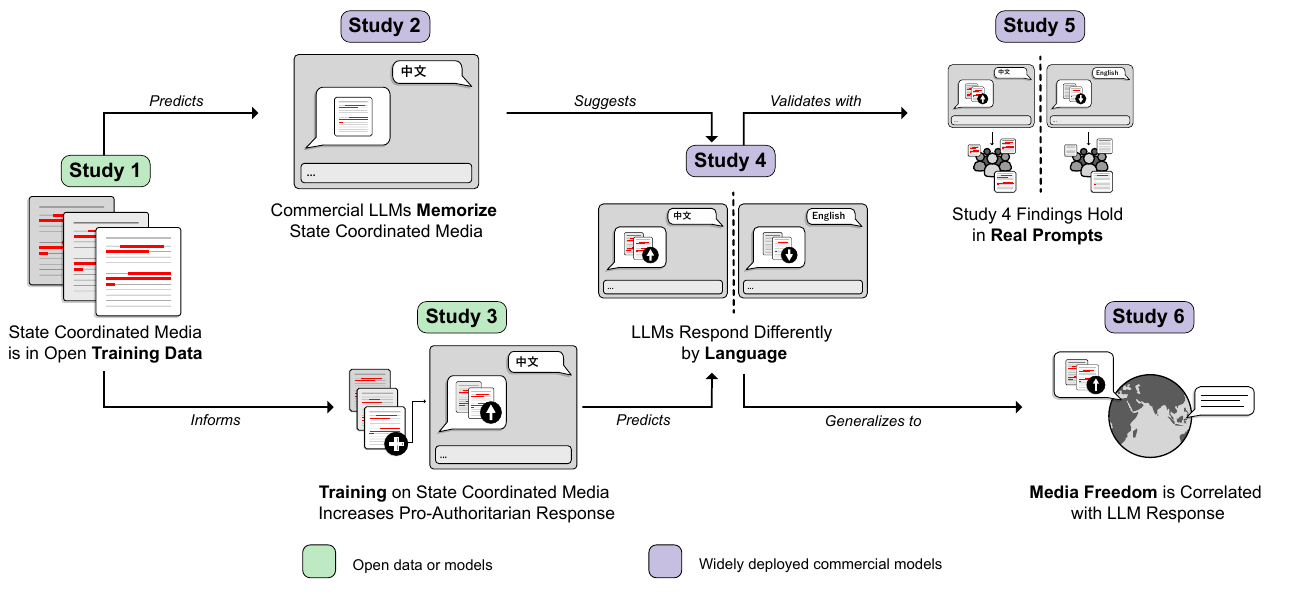
Millions of people around the world query large language models for information. While several studies have compellingly documented the persuasive potential of these models, there is limited evidence of who or what influences the models themselves, leading to a flurry of concerns about which companies and governments build and regulate the models. We show through six studies that government control of the media across the world already influences the output of large language models (LLMs) via their training data. We use a cross-national audit to show that LLMs exhibit a stronger pro-government valence in the languages of countries with lower media freedom than those with higher media freedom. This result is correlational so to triangulate the specific mechanism of how state media control can influence LLMs, we develop a multi-part case study on China's media. We demonstrate that media scripted and curated by the Chinese state appears in large language model training datasets. To evaluate the plausible effect of this inclusion, we use an open-weight model to show that additional pretraining on Chinese state-coordinated media generates more positive answers to prompts about Chinese political institutions and leaders. We link this phenomenon to commercial models through two audit studies demonstrating that prompting models in Chinese generates more positive responses about China's institutions and leaders than do the same queries in English. The combination of influence and persuasive potential across languages suggests the troubling conclusion that states and powerful institutions have increased strategic incentives to leverage media control in the hopes of shaping large language model output.
Selected Coverage
Related Publications
- [Paper] The Decade-Long Growth of Government-Authored News Media in China under Xi Jinping
- [Paper] Fine-Tuned Large Language Models Can Replicate Expert Coding Better Than Trained Coders: A Study on Informative Signals Sent by Interest Groups
- [Conference Proceedings] AutoPersuade: A Framework for Evaluating and Explaining Persuasive Arguments
- [Conference Proceedings] GPT Deciphering Fedspeak: Quantifying Dissent Among Hawks and Doves
- [Working Paper] Where's the Evidence that Respondents Understand Your Survey Questions?
- [Conference Proceedings] STATe-of-Thoughts: Structured Action Templates for Tree-of-Thoughts
- [Paper] Using Large Language Model Annotations for the Social Sciences: A General Framework of Using Predicted Variables in Downstream Analyses
- [Paper] Short-Term Exposure to "Filter-Bubble" Recommendation Systems Has Limited Polarization Effects: Naturalistic Experiments on YouTube