Short-Term Exposure to "Filter-Bubble" Recommendation Systems Has Limited Polarization Effects: Naturalistic Experiments on YouTube
Proceedings of the National Academy of Sciences 122(8): e2318127122, 2025.
Abstract
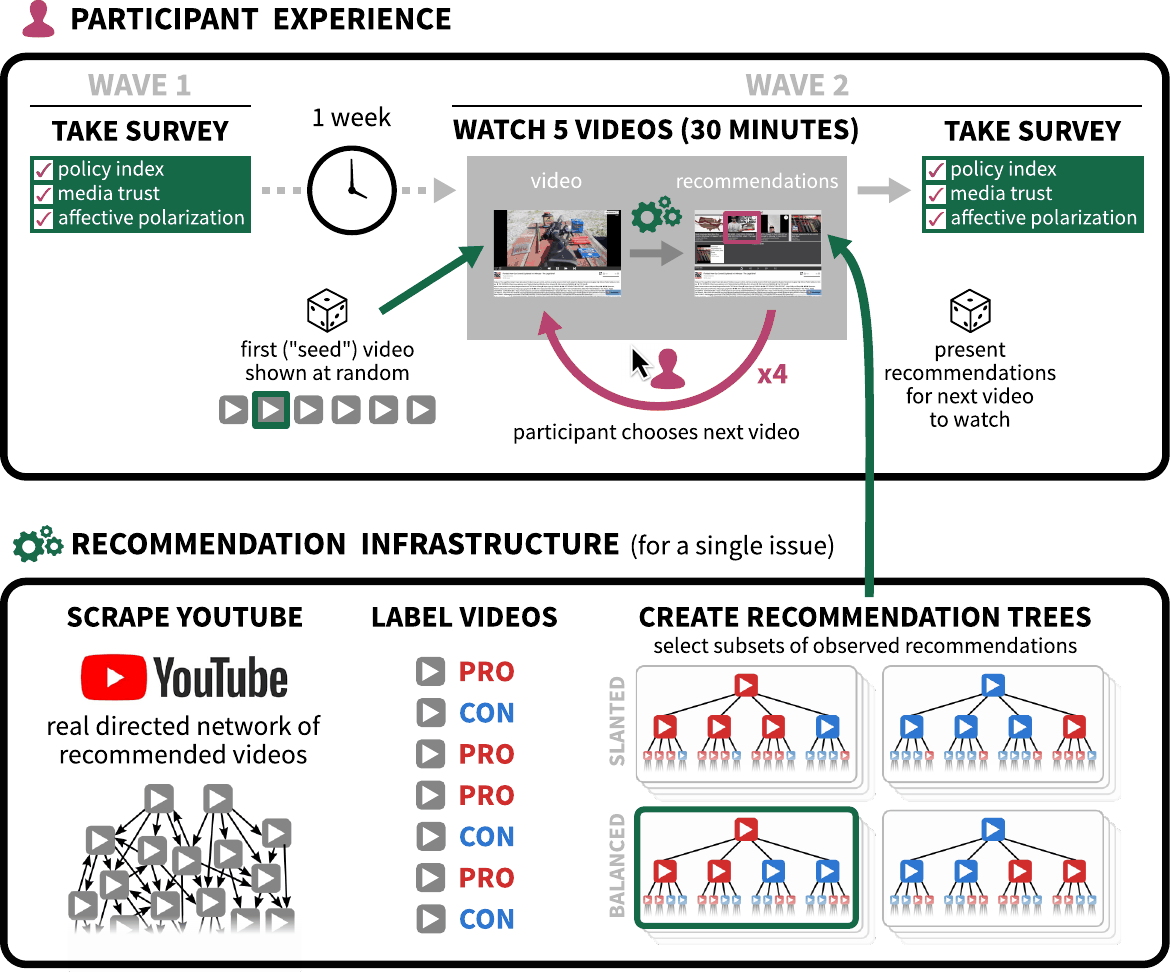
An enormous literature argues that recommendation algorithms drive political polarization by creating "filter bubbles" and "rabbit holes." Using four experiments with nearly 9,000 participants, we show that manipulating algorithmic recommendations to create these conditions has limited effects on opinions. Our experiments employ a custom-built video platform with a naturalistic, YouTube-like interface presenting real YouTube videos and recommendations. We experimentally manipulate YouTube's actual recommendation algorithm to simulate "filter bubbles" and "rabbit holes" by presenting ideologically balanced and slanted choices. Our design allows us to intervene in a feedback loop that has confounded the study of algorithmic polarization - the complex interplay between supply of recommendations and user demand for content - to examine downstream effects on policy attitudes. We use over 130,000 experimentally manipulated recommendations and 31,000 platform interactions to estimate how recommendation algorithms alter users' media consumption decisions and, indirectly, their political attitudes. Our results cast doubt on widely circulating theories of algorithmic polarization by showing that even heavy-handed (although short-term) perturbations of real-world recommendations have limited causal effects on policy attitudes. Given our inability to detect consistent evidence for algorithmic effects, we argue the burden of proof for claims about algorithm-induced polarization has shifted. Our methodology, which captures and modifies the output of real-world recommendation algorithms, offers a path forward for future investigations of black-box artificial intelligence systems. Our findings reveal practical limits to effect sizes that are feasibly detectable in academic experiments.
Related Publications
- [Conference Proceedings] How Algorithmic Confounding in Recommendation Systems Increases Homogeneity and Decreases Utility
- [Paper] REFORMS: Consensus-Based Recommendations for Machine-Learning-Based Science
- [Paper] Machine Learning for Social Science: An Agnostic Approach
- [Paper] Wrestling with Complexity in Computational Social Science: Theory, Estimation, and Representation
- [Paper] The Civic Mission of MOOCs: Engagement across Political Differences in Online Forums
- [Conference Proceedings] The Civic Mission of MOOCs: Measuring Engagement across Political Differences in Forums
- [Conference Proceedings] EgoPolice: A Benchmark for Egocentric Video Understanding in High-Stakes Police Body-Worn Camera Footage
- [Paper] Naive Regression Requires Weaker Assumptions than Factor Models to Adjust for Multiple Cause Confounding