Naive Regression Requires Weaker Assumptions than Factor Models to Adjust for Multiple Cause Confounding
Journal of Machine Learning Research 24(182): 1-70, 2023.
Abstract
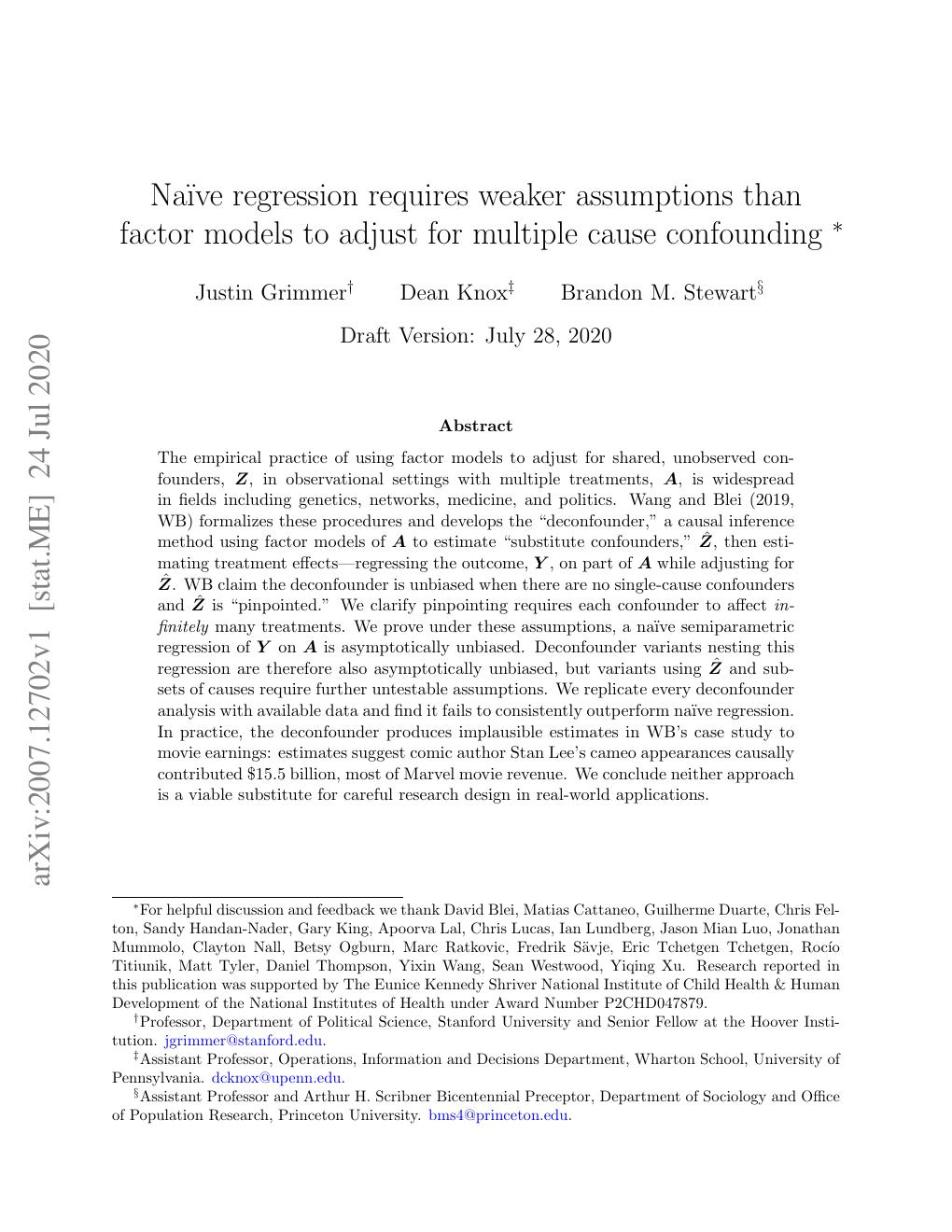
The empirical practice of using factor models to adjust for shared, unobserved confounders, Z, in observational settings with multiple treatments, A, is widespread in fields including genetics, networks, medicine, and politics. Wang and Blei (2019, WB) formalizes these procedures and develops the "deconfounder," a causal inference method using factor models of A to estimate "substitute confounders," Ẑ , then estimating treatment effects by regressing the outcome, Y, on part of A while adjusting for Ẑ . WB claim the deconfounder is unbiased when there are no single-cause confounders and Ẑ is "pinpointed." We clarify pinpointing requires each confounder to affect infinitely many treatments. We prove under these assumptions, a naïve semiparametric regression of Y on A is asymptotically unbiased. Deconfounder variants nesting this regression are therefore also asymptotically unbiased, but variants using Ẑ and subsets of causes require further untestable assumptions. We replicate every deconfounder analysis with available data and find it fails to consistently outperform naïve regression. In practice, the deconfounder produces implausible estimates in WB's case study to movie earnings: estimates suggest comic author Stan Lee's cameo appearances causally contributed $15.5 billion, most of Marvel movie revenue. We conclude neither approach is a viable substitute for careful research design in real-world applications.
Related Publications
- [Paper] Short-Term Exposure to "Filter-Bubble" Recommendation Systems Has Limited Polarization Effects: Naturalistic Experiments on YouTube
- [Paper] Machine Learning for Social Science: An Agnostic Approach
- [Working Paper] Where's the Evidence that Respondents Understand Your Survey Questions?
- [Paper] Handle with Care: A Sociologist's Guide to Causal Inference with Instrumental Variables
- [Paper] What Good Is a Regression? Inference to the Best Explanation and the Practice of Political Science Research
- [Paper] Correcting the Measurement Errors of AI-Assisted Labeling in Image Analysis Using Design-Based Supervised Learning
- [Paper] Measuring Distances in High-Dimensional Spaces: Why Average Group Vector Comparisons Exhibit Bias, and What to Do About It
- [Paper] REFORMS: Consensus-Based Recommendations for Machine-Learning-Based Science