EgoPolice: A Benchmark for Egocentric Video Understanding in High-Stakes Police Body-Worn Camera Footage
European Conference on Computer Vision (ECCV), 2026.
Abstract
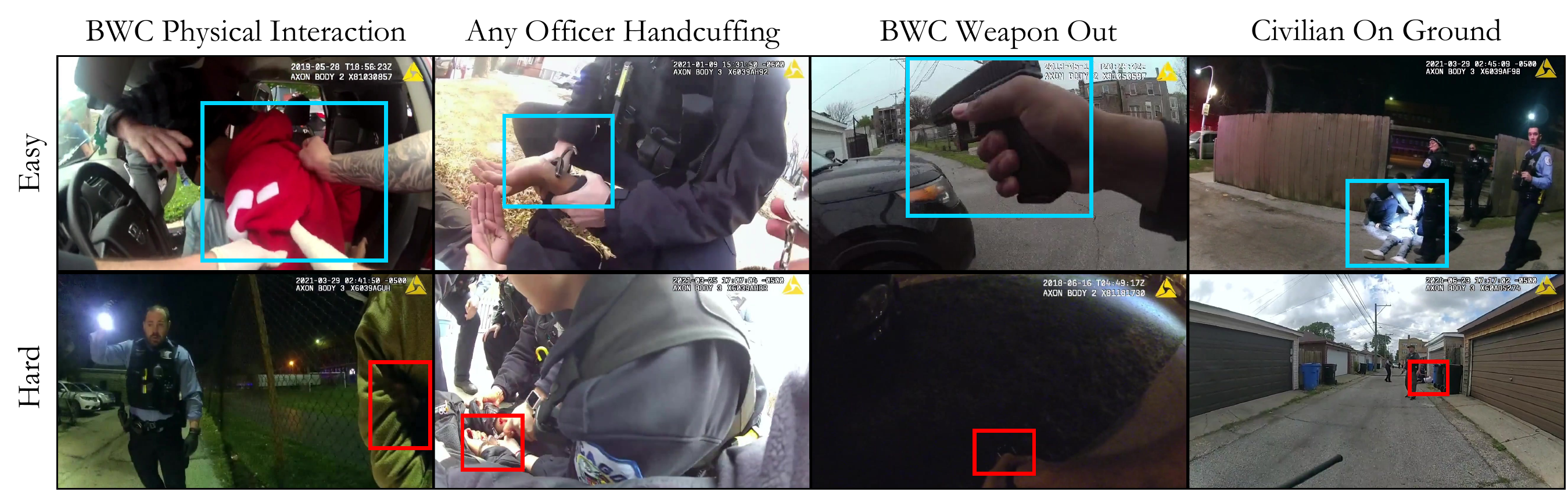
We introduce EgoPolice, a carefully curated dataset of real, egocentric police-civilian interactions, sourced from publicly available body-worn camera videos. We select police-civilian action labels that are critical for police behavioral research and annotate them at a second-by-second granularity. The videos feature rapid and irregular camera motion, dense human interactions, and rare high-stakes events, making the dataset a challenging benchmark for motion-robust and context-aware egocentric perception. We provide two different tasks, classification and multiple-choice question-answering, and benchmark both open-source and closed-source models. We find that even the best video models like Gemini 2.5 Pro still struggle to accurately predict high-risk actions such as "Weapon Out". Beyond serving as a benchmark, EgoPolice provides a foundation for developing models capable of identifying events of interest in large-scale body-worn camera video repositories, enabling more efficient downstream human review.
Related Publications
- [Paper] Correcting the Measurement Errors of AI-Assisted Labeling in Image Analysis Using Design-Based Supervised Learning
- [Paper] Short-Term Exposure to "Filter-Bubble" Recommendation Systems Has Limited Polarization Effects: Naturalistic Experiments on YouTube
- [Paper] Fine-Tuned Large Language Models Can Replicate Expert Coding Better Than Trained Coders: A Study on Informative Signals Sent by Interest Groups
- [Paper] Using Large Language Model Annotations for the Social Sciences: A General Framework of Using Predicted Variables in Downstream Analyses
- [Conference Proceedings] More Victories, Less Cooperation: Assessing Cicero's Diplomacy Play
- [Paper] REFORMS: Consensus-Based Recommendations for Machine-Learning-Based Science
- [Conference Proceedings] GPT Deciphering Fedspeak: Quantifying Dissent Among Hawks and Doves
- [Conference Proceedings] Using Imperfect Surrogates for Downstream Inference: Design-Based Supervised Learning for Social Science Applications of Large Language Models