The Decade-Long Growth of Government-Authored News Media in China under Xi Jinping
Proceedings of the National Academy of Sciences 122(11): e2408260122, 2025.
Abstract
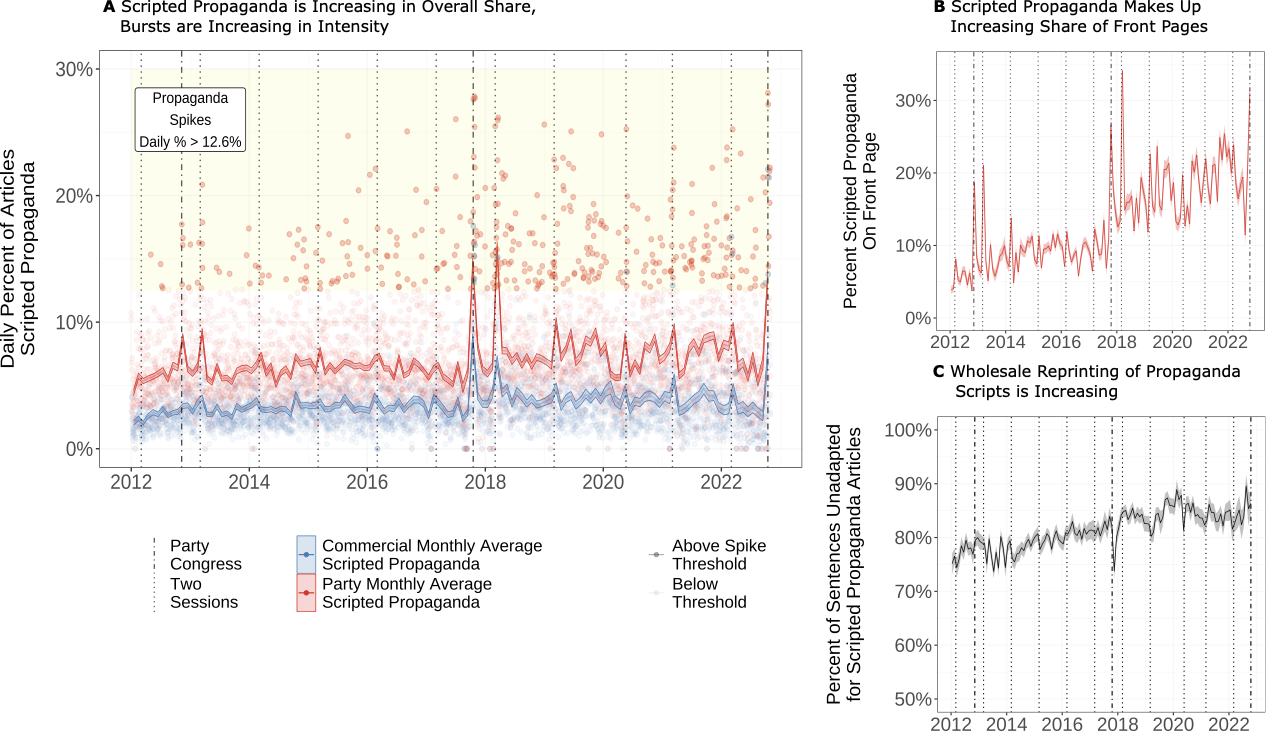
Autocratic governments around the world use clandestine propaganda campaigns to influence the media. We document a decade-long trend in China towards the planting of government-authored articles in party and commercial newspapers. To examine this phenomenon, we develop a new approach to identifying scripted propaganda - the coerced reprinting of lightly-adapted government-authored articles in newspapers - that leverages the footprints left by the government when making media interventions. We show that in China, scripted propaganda is a daily phenomenon - on 90% of days from 2012-2022, the vast majority of party newspapers include at least some scripted propaganda at the direction of a central directive. On particular sensitive days, the amount of scripted propaganda can spike to 30% of the articles appearing in major newspapers. We show that scripted propaganda has strengthened under President Xi Jinping. In the last decade the front page of party newspapers has evolved from 5% scripted articles to approximately 20% scripted. This government-authored content throughout the paper is increasingly homogeneous - fewer and fewer adaptations are done by individual newspapers. In contrast to popular speculation, we show that scripted content is not only on ideological topics (although it is increasingly ideological) and is also very prevalent in commercial papers. Using a case study of domestic coverage of COVID-19, we demonstrate how the regime uses scripting to shape, constrain, and delay information during crises. Our findings reveal the wide-ranging influence of government-authored propaganda in the Chinese media ecosystem.
Related Publications
- [Paper] State Media Control Influences Large Language Models
- [Paper] Fine-Tuned Large Language Models Can Replicate Expert Coding Better Than Trained Coders: A Study on Informative Signals Sent by Interest Groups
- [Paper] Short-Term Exposure to "Filter-Bubble" Recommendation Systems Has Limited Polarization Effects: Naturalistic Experiments on YouTube
- [Conference Proceedings] AutoPersuade: A Framework for Evaluating and Explaining Persuasive Arguments
- [Conference Proceedings] GPT Deciphering Fedspeak: Quantifying Dissent Among Hawks and Doves
- [Paper] Manipulative Tactics Are the Norm in Political Emails: Evidence from 300K Emails from the 2020 U.S. Election Cycle
- [Paper] The Civic Mission of MOOCs: Engagement across Political Differences in Online Forums
- [Conference Proceedings] The Civic Mission of MOOCs: Measuring Engagement across Political Differences in Forums