Correcting the Measurement Errors of AI-Assisted Labeling in Image Analysis Using Design-Based Supervised Learning
Sociological Methods & Research 54(3): 984-1016, 2025.
Abstract
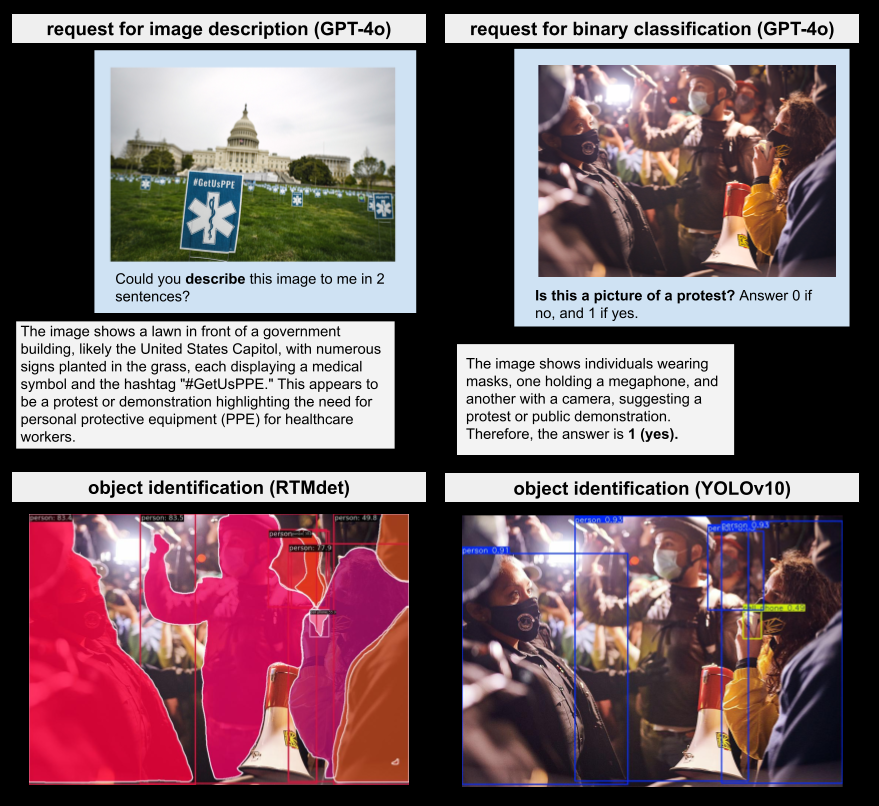
Generative artificial intelligence (AI) has shown incredible leaps in performance across data of a variety of modalities including texts, images, audio, and videos. This affords social scientists the ability to annotate variables of interest from unstructured media. While rapidly improving, these methods are far from perfect and, as we show, even ignoring the small amounts of error in high accuracy systems can lead to substantial bias and invalid confidence intervals in downstream analysis. We review how using design-based supervised learning (DSL) guarantees asymptotic unbiasedness and proper confidence interval coverage by making use of a small number of expert annotations. While originally developed for use with large language models in text, we present a series of applications in the context of image analysis, including an investigation of visual predictors of the perceived level of violence in protest images, an analysis of the images shared in the Black Lives Matter movement on Twitter, and a study of US outlets reporting of immigrant caravans. These applications are representative of the type of analysis performed in the visual social science landscape today, and our analyses will exemplify how DSL helps us attain statistical guarantees while using automated methods to reduce human labor.
Related Publications
- [Paper] Using Large Language Model Annotations for the Social Sciences: A General Framework of Using Predicted Variables in Downstream Analyses
- [Conference Proceedings] Using Imperfect Surrogates for Downstream Inference: Design-Based Supervised Learning for Social Science Applications of Large Language Models
- [Conference Proceedings] EgoPolice: A Benchmark for Egocentric Video Understanding in High-Stakes Police Body-Worn Camera Footage
- [Working Paper] Where's the Evidence that Respondents Understand Your Survey Questions?
- [Paper] Fine-Tuned Large Language Models Can Replicate Expert Coding Better Than Trained Coders: A Study on Informative Signals Sent by Interest Groups
- [Paper] Handle with Care: A Sociologist's Guide to Causal Inference with Instrumental Variables
- [Paper] What Good Is a Regression? Inference to the Best Explanation and the Practice of Political Science Research
- [Paper] Short-Term Exposure to "Filter-Bubble" Recommendation Systems Has Limited Polarization Effects: Naturalistic Experiments on YouTube